
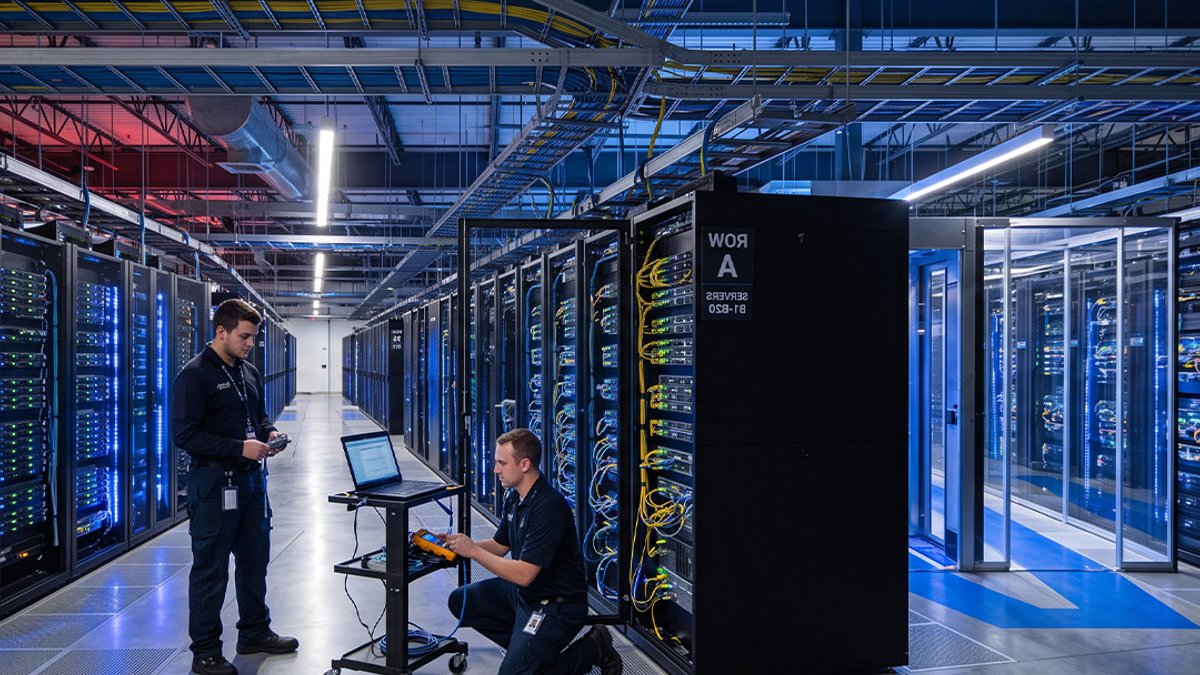
A fivefold rise in spending on data centre infrastructure since 2020 has positioned Australia as a leading global destination for computing power. However, this expansion—driven by surging demand for artificial intelligence and cloud services—now confronts multiple challenges that could alter its trajectory.
Data centres remain essential to digital operations, supporting cloud storage, website hosting, and enterprise computing. While traditional workloads still occupy roughly half of global capacity, the shift toward AI introduces new demands. Unlike conventional centres designed around central processing units, AI-focused facilities depend on graphics processing units, which consume significantly more electricity and generate greater heat. McKinsey estimates that AI-related activities will exceed half of all data centre operations by 2030.
The industry’s growth has been swift. Australia’s capital expenditure on data centres has climbed alongside global investment, supported by low-cost power, available land, and government incentives. Major cloud providers such as Amazon, Microsoft, and Google have announced billions more in planned investments through 2030. Yet five distinct risks threaten to disrupt this momentum.
Power demand is straining grid capacity
Electricity represents the largest operational expense for data centres, accounting for 40% to 60% of their budgets. Worldwide, data centre power consumption has doubled since 2020, now approaching 2% of global electricity use. The International Energy Agency forecasts another doubling by 2033. In Australia, data centres already consume about 2% of the national grid’s output, but this share could expand to 10% over the next decade.
Grid limitations are already impeding development. Delays for new connections stretch from three years in Sydney to up to ten years in Amsterdam and Tokyo, according to JLL. Without adequate generation or transmission infrastructure, data centres may compete directly with residential and industrial users, driving up costs and restricting expansion. Their continuous power needs could also delay the transition to renewable energy by prolonging reliance on fossil fuel plants.
Efficiency improvements are helping to ease some pressure. The IEA reports that energy use per AI task has declined by roughly 90% annually in recent years. A basic text query now requires less power than running a television for the same duration. Companies like DeepSeek and Moonshot AI are achieving comparable performance using older, less energy-intensive hardware. Despite these gains, overall demand will continue rising as AI adoption expands.
Large-scale facilities could also enhance grid stability by absorbing surplus renewable energy when production exceeds demand. Research from Berkeley Lab indicates that predictable data centre loads help distribute fixed costs more broadly. Some governments are imposing renewable energy requirements: new centres in Ireland must derive 80% of their power from additional renewables, while Singapore mandates at least 50% green energy for new capacity.
This suggests data centre investments may accelerate renewable deployment, acting as a key customer for wind, solar, and battery projects. However, the timing of these benefits remains uncertain.
Debt financing is becoming more precarious
Data centres are increasingly reliant on corporate bonds and off-balance-sheet structures rather than equity or operational cash flow. The five largest hyperscalers have issued over $100 billion in bonds each of the past two years, with long-term debt aligned to multi-year construction schedules. Yet on-balance-sheet debt now covers only about a quarter of this year’s planned spending—and an even smaller portion of next year’s.
The shortfall is being filled by special purpose vehicles that secure funding through long-term commitments, such as leases or power purchase agreements. These off-balance-sheet obligations are growing faster than traditional debt, but transparency about their terms remains inconsistent. Investors face difficulties assessing leverage, cash flow risks, and concentration exposure, particularly for lower-rated firms like OpenAI and Anthropic, which depend on equity partnerships.
Three key risks emerge. First, the complexity of contracts obscures interconnected financial exposures. Second, rising interest rates or widening credit spreads could strain refinancing as these debts mature in five years. While spreads have recently tightened, further Federal Reserve rate hikes could reverse this trend, especially for weaker issuers like Oracle, which carries a BBB rating with a negative outlook. Third, this asset class lacks historical performance data and has not yet been tested through a full economic downturn.
As the market matures, weaker deals will likely surface, helping to standardize terms and reveal hidden risks. Hyperscalers retain some flexibility: if revenue falls short, they can sublease space to more successful operators. But in a broader downturn, this safeguard weakens. For now, strong balance sheets and signed customer contracts support major players, though long-term overcapacity could still depress valuations.
The financing challenge extends beyond debt. Construction and equipment installation can take years, creating a mismatch between upfront costs and delayed revenue. If semiconductor technology becomes obsolete quickly, or if competitors, particularly Chinese AI developers, capture market share, some facilities may end up underutilized. Hyperscalers could struggle to justify long-term lease commitments if returns do not materialize.
However, the broader data centre market extends beyond AI training. Cloud storage, cybersecurity, and enterprise workloads remain robust growth areas, relying on lower-end chips that may prove more resilient during economic slowdowns.
Local opposition is intensifying
Community resistance is emerging as a significant obstacle. In the United States, projects have faced disruptions due to opposition. This November’s midterm elections will include 34 ballot measures related to data centres, while 40 states have active bans or moratoriums in place. In Sydney, residents successfully blocked Goodman Group’s proposed 90-megawatt, 24-hour facility in Lane Cove.
Sydney already hosts major facilities, including NextDC’s 93-megawatt Artarmon complex, which operates near residential areas with minimal local resistance. Yet the Lane Cove rejection indicates even established operators now face heightened scrutiny. Without stronger community engagement, approval delays and increased compliance costs could limit available sites, particularly in Australia, where construction productivity is already constrained.


